Weak showers, taps that die when someone flushes, a tank that can’t push water upstairs – a booster pump fixes all of these, if it is sized for the flow and pressure your house actually needs. Here is how to choose one in plain language, with two worked examples.
1. How much water do you use at once?
Count the outlets that realistically run at the same time and add up their flow:
| Outlet | Typical flow |
|---|---|
| Shower | 9–12 L/min |
| Basin or kitchen tap | 6–8 L/min |
| Toilet cistern filling | 6 L/min |
| Washing machine / dishwasher | 8–10 L/min |
| Garden hose | 15–20 L/min |
A small home with one bathroom is usually well served by about 20 L/min (1.2 m³/h); a family home with two bathrooms by 30–40 L/min (1.8–2.4 m³/h).
2. How much pressure do you need?
Around 2–3 bar at the highest tap feels like good mains pressure. Convert it to metres of head and add the height and the losses:
Head needed (m) = pressure in bar × 10.2 + height of the highest outlet above the pump + about 10–20% for pipes and fittings3. Match it to a pump curve
Every pump has a curve showing the head it delivers at each flow. Pick a pump whose curve is above your duty point (your flow and head), not just one with a big “max head” number – that figure is at zero flow. On our product pages, the “Check your duty point” tool under each pump curve does the comparison for you.
Example 1: single-storey home, one bathroom
20 L/min (1.2 m³/h) at 2.5 bar: 2.5 × 10.2 = 25.5 m + 1 m height + about 3 m for pipes ≈ 30 m at 1.2 m³/h.
A QB80 peripheral pump gives about 43 m at that flow – plenty of pressure for a small household at low cost. A CPM170 centrifugal pump (about 33 m) also works and handles bigger flows better.
Example 2: double-storey home, two bathrooms
30 L/min (1.8 m³/h) at 3 bar: 3 × 10.2 = 30.6 m + 6 m to the upstairs shower + about 4 m for pipes ≈ 40 m at 1.8 m³/h.
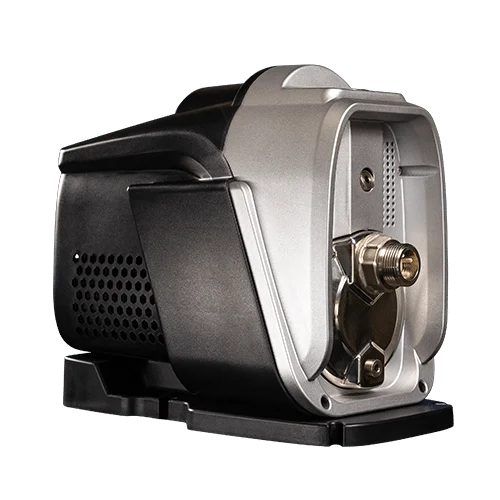
The RUC 750 smart VSD booster pump delivers about 44 m at that flow and holds the pressure constant as taps open and close. A 2CPM25/140M twin-stage pump (about 43 m) is a solid fixed-speed alternative.
4. Choose the right type
- Peripheral pumps (QB) – high pressure at small flows. Compact and affordable for small homes and single points.
- Centrifugal pumps (CPM) – more flow, quieter, great for general household boosting and irrigation.
- Twin-stage pumps (2CPM) – two impellers for higher pressure at household flows, e.g. double-storey homes.
- Smart VSD pumps (RUC, SSP-100) – the motor speeds up and slows down to hold a constant pressure. Quieter, soft starting, and they use less electricity because they only work as hard as needed.
5. Pick the pressure control
- Automatic flow controller (e.g. PS18L) – starts the pump when a tap opens and stops it when flow stops, with dry-run protection. Simple and compact.
- Pressure tank and pressure switch – the tank stores a little water under pressure so the pump doesn’t start for every glass of water.
- VSD pumps have constant-pressure control built in.
Our booster pump combos come with the controller and fittings already matched.
Installation tips
- Pump from a storage tank. Most municipalities don’t allow a booster pump to be connected directly to the municipal supply – pump from a tank instead.
- Keep the suction pipe short and at least as large as the pump inlet, and fit a non-return (foot) valve if the pump sits above the water level.
- Shelter the pump from sun and rain and leave room for ventilation.
- Give it its own circuit with the correct breaker and earth-leakage protection – have a qualified electrician do the wiring.
Not sure which one?
Tell us how many bathrooms you have, whether the house is single- or double-storey and where the water comes from – we will recommend the right booster pump.